
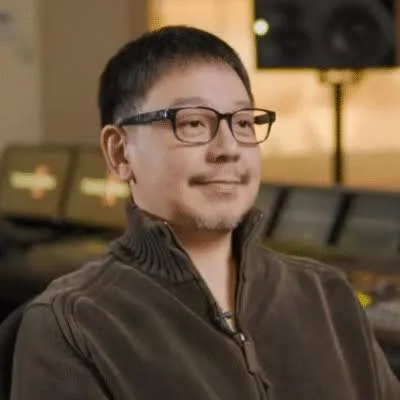
LUDAMUSEA COMPOSER PORTRAIT · ORIGINAL FEATURE
Hitoshi Sakimoto: The Man Who Wrote the Driver Before the Melody
Prologue: Beginning at the Foundation of Sound
Some composers in video game music history entered game companies through music conservatories. Others entered music through code. Hitoshi Sakimoto belongs to the latter group, and few have taken that path as far as he has.
He never received formal musical training. What he genuinely wanted to become in his early years was a game programmer. His way into the industry was not, "I wrote a good piece of music," but, "I wrote a driver that could make an FM sound source sound better" - and then he wrote the music as well. That starting point determined the texture of nearly four decades of work: his understanding of sound has always begun with chips, channel counts, and memory budgets, rather than with staff paper.
To understand Sakimoto is to understand how a technical mind used an engineer's methodology to bring video game music to orchestral scale and density.
Technical constraint came before style; style was the consequence of constraint.
1. His Youth: Oh!FM, YMO, and an FM-7 Fitted with a Z80 Board
Hitoshi Sakimoto was born in Tokyo on February 26, 1969. He taught himself piano and electronic organ in elementary school, then joined both a concert band as a percussionist and a rock band in junior high. That concert-band experience is worth remembering: the forward motion created by brass and military drums in his later battle music most likely has roots here.
In high school, he was thoroughly a "computer, game, and music geek" and wrote for the computer magazine Oh!FM. His most direct musical influences were Yellow Magic Orchestra (YMO) and jazz keyboardist Chick Corea, alongside music from Nihon Falcom games. His early alias, "YmoH.S" (pronounced "imo-esu"), was itself a tribute to YMO. The detail is revealing: a composer who would later become famous for orchestral music actually began with electronic music.
What truly set him apart was the FM sound driver he programmed himself to improve game audio. He named it Terpsichorean, after Terpsichore, the Greek Muse of dance and chorus. Its prototype grew out of a driver he wrote while working on an X1 port. For the basic development of his debut title, he used an FM-7 fitted with a Z80 development board in a CP/M environment.
The driver extracted remarkably clean results from the built-in YM2203 FM chip: three FM voices plus three SSG voices, for only six sound channels in total. In the early 1990s, numerous Japanese PC-98 and Mega Drive games used it. Retrospective coverage outside Japan later described it as an "unparalleled synthesizer driver." The timbres in the Mega Drive version of Midnight Resistance are still cited as examples.
It is worth pausing here. What do six voices mean? If four are used for harmony, only two remain for melody and bass. Every choice of timbre becomes a zero-sum decision. To some extent, Sakimoto's later habit of dense chromatic motion and frequent modulation emerged from producing information through harmonic movement rather than stacked orchestration on an extremely constrained sound source. Technical constraint came before style; style was the consequence of constraint.
2. 1988, REVOLTER: A Debut and a Lifelong Collaborator
In 1988, the doujin circle A.S.C.Group released the vertically scrolling shooter REVOLTER for the NEC PC-8801mkIISR. The music was co-composed by Hitoshi Sakimoto and Masaharu Iwata.
This was both Sakimoto's debut as a composer and the project through which he met Iwata, then a part-time employee at Bothtec. For more than thirty years afterward, their names would repeatedly appear together in game music history: the Ogre series, Final Fantasy Tactics, and Final Fantasy XII, before they co-founded a company in 2002.
A music cassette containing only the BGM, MUSIC FROM REVOLTER, was also released. One frequently repeated anecdote says that a piece from REVOLTER caught the attention of the president at Iwata's part-time workplace and was later used in the Famicom version of Daisenryaku. Music moving from a doujin work into a commercial title was not unusual in Japan's late-1980s PC scene, but it was Sakimoto's first stepping stone into a professional career.
3. 1990-1992: A "Sound Programmer" Borrowed Across the Industry
In the two or three years after his debut, Sakimoto was almost pursued by the industry as a piece of "technical capital." Between 1990 and 1992, he participated in more than twenty projects for different companies, including Toshiba EMI, Artec, and Data East. Bubble Ghost (1990) was the first score he handled alone.
During this period, he often worked as a sound programmer and arranger, creating drivers or arrangements for ports such as the Mega Drive versions of Midnight Resistance, Eye of the Beholder, and Crude Buster.
Of particular interest to Chinese readers, he also handled sound programming for Kyuuyaku Megami Tensei (Atlus), Dragon Quest VI (arrangement and sound effects), and the Super Famicom version of Dragon Quest III. It is said that Koichi Sugiyama himself was deeply impressed by the orchestral timbres in the latter.
In other words, Sakimoto is one of the very few people to have left a technical mark on both of Japan's two national RPG institutions, Final Fantasy and Dragon Quest. That distinction is exceptionally rare in the history of Japanese game music.
4. 1993-1996, the Quest Era: The Ogre Series and the Formation of a Core Trio
Ogre Battle: The March of the Black Queen (1993)
Directed by Yasumi Matsuno and scored by Hitoshi Sakimoto, Masaharu Iwata, and Hayato Matsuo, this was Sakimoto's first mainstream success in Japan and the starting point for his reputation as a pioneer of orchestral writing in game music.
From then on, Matsuno made Sakimoto a regular member of his development team. The combination of Yasumi Matsuno (director), Hitoshi Sakimoto (music), and Masaharu Iwata (music) would continue through Final Fantasy Tactics, Vagrant Story, and Final Fantasy XII, collectively forming the famous "sound of Ivalice."
Tactics Ogre: Let Us Cling Together (1995)
Sakimoto and Iwata again collaborated on the score. Compared with its predecessor, the music is more delicate and expansive, with greater emotional depth. Sakimoto has described "Passing Moment" as a piece that demanded particular compositional effort.
Long-running fan discussions have produced a broadly shared impression of their division of labor: within the same work, Iwata tends toward weight and rhythmic drive, while Sakimoto tends toward religious coloration and accumulated emotion. The distinction does not necessarily map onto every individual track, but it remains a useful listening entry point.
Other works from this period include Treasure Hunter G (1996, with multiple composers) and Terra Diver / Soukyugurentai (1996, solo composition). The latter, together with Radiant Silvergun, forms an important branch of his shooter music. Its style is entirely different from his RPG work and deserves to be heard on its own terms.
5. 1997-2000, the Square Era: Two Creative Peaks
Final Fantasy Tactics (1997)
Core members of the Ogre development team moved to Square, and Sakimoto joined the project. He and Iwata again co-composed the music. By track count, Sakimoto wrote 46 pieces and Iwata 25, for a total of 71. Sakimoto spent roughly half a year on the project and handled most cutscene music, battle pieces, and character themes.
The soundtrack was released by DigiCube on June 21, 1997, and reissued on March 24, 2006. It reached No. 62 on the Oricon chart and sold more than 12,000 copies.
This was Sakimoto's first widely known work overseas. Before Final Fantasy XII appeared in 2006, nearly every listener outside Japan who knew Hitoshi Sakimoto had encountered him through FFT. "Trisection" and "Antipyretic" remain among his most frequently cited pieces.
Vagrant Story (2000)
This was the only game Sakimoto scored in full as a formal Square employee, and it is a work he has repeatedly named among his personal favorites.
The production process contains a revealing detail. His initial music was bright and close to the style of FFT, but Matsuno rejected it and asked for something "deeper and heavier." Matsuno also suggested listening to music from The X-Files as inspiration for ambience. Sakimoto has acknowledged traces of James Horner and Hans Zimmer as well. He wrote themes for each character and monster, transforming their melodies to reflect relationships and emotional opposition.
Technically, the game is a specimen-level case study: almost everything uses the PlayStation's internal sound source, with live instruments appearing only in one orchestral piece by the Shinozuka Group during the ending credits. For the 2006 reissue (SQEX-10068/9), some of the synthetic reverb from the original PlayStation version was removed. Takeharu Ishimoto took the lead in synthesizer operation.
In a 1999 Ultimania developer interview, Sakimoto explained in essence that he had never consciously set out to become a musician. He simply loved games; composing and programming music for doujin games with friends in high school became his real turning point.
Recommended Listening
- "Trisection" (FFT) - The standard gateway to the "Sakimoto-style battle piece": momentum, dense modulation, and alternating advances by brass and strings
- "Antipyretic" (FFT) - The lyrical side of the same vocabulary
- The main theme of Vagrant Story - Hear how he creates a "heavy atmosphere" with limited sound hardware
6. 2002, Basiscape: A Company Founded by a Composer
On October 4, 2002, Hitoshi Sakimoto, Manabu Namiki, and Masaharu Iwata jointly established Basiscape Co., Ltd., with Sakimoto serving as representative director and president. The company began with only three members.
Across different interviews, he has given two complementary explanations for becoming independent. One was a desire for greater freedom in choosing projects, though he also admitted that freedom made it difficult to maintain close collaboration with development teams. The other is closer to an industrial argument. In a 2016 CRI Middleware interview, he explained in essence that after twelve years as a freelancer, he realized that loose collaboration among independent creators had begun to show its limits in the face of large-scale game development. It was no longer the optimal arrangement, so he formed a company.
Basiscape's workshop model is its most important feature:
- It provides a complete range of game-audio services, from composition and sound design to voice recording
- Members can accept individual projects under the Basiscape name or form internal collaborative teams
- The result is a structure between freelance work and formal employment: creators retain personal credits and individual styles while gaining stable workflow and business support
This structure fostered a generation of established composers, including Mitsuhiro Kaneda, Yoshimi Kudo, Kimihiro Abe, Noriyuki Kamikura, Azusa Chiba, Masaaki Kaneko, Toki Takeda, Rikako Watanabe, Mai Hamano, and Kazuki Higashihara. Of the original trio, Manabu Namiki later moved to M2 and Grid before becoming independent; Masaharu Iwata left the company in 2017 and returned to freelance work.
Sakimoto's advice to young composers in the CRI interview was almost prosaically simple: keep making things, one work after another; set a precise goal for each project, complete it, move to the next, and always be writing something new.
He also founded Basiscape Records in 2009, which has released numerous soundtracks. In June 2025, Basiscape placed 46 previously digitally released albums on major streaming services including Apple Music and Spotify, while also adding works such as Saihate no Babel, World End Eclipse, and MyTale.
7. 2006, Final Fantasy XII: Inheriting an Impossible Position
This was the first mainline Final Fantasy whose score was not led by Nobuo Uematsu.
Sakimoto was invited by Yasumi Matsuno five months before the game was formally announced. He has said that the pressure was immense. For a long time he wrestled with whether he should imitate Uematsu's style, before ultimately deciding to write in his own way.
In terms of credits, Sakimoto was the principal composer. Masaharu Iwata and Hayato Matsuo added compositions and handled the orchestral arrangements for the opening and ending; Nobuo Uematsu contributed only the theme song "Kiss Me Good-Bye" (Uematsu had left Square Enix in 2004). This is often misreported and deserves to be stated repeatedly.
In a 2022 PlayStation.Blog interview, Sakimoto described his creative concept in unusually concrete terms. He centered the music on "bright and colorful" chord progressions and orchestration and intentionally avoided negative emotion. Even where negative emotions had to appear, he consciously built pathways leading toward positivity.
Technically, FFXII sits at a point of transition. The opening and ending were live-recorded and mixed in Dolby Pro Logic, while most of the in-game music still used the console's internal sound source. This also explains why many listeners felt that the OST version sounded "wider" than what they remembered from the game.
One context must be mentioned: Yasumi Matsuno left the FFXII project during development. It remains the last mainline work on which Sakimoto and Matsuno have collaborated. Years later, Sakimoto continued to express a desire to return to Ivalice. If given the choice, he has said he would choose Ogre Battle first.
8. Vanillaware: A Seventeen-Year Relationship
Beginning with Odin Sphere (2007), Sakimoto formed a long-term working relationship with George Kamitani's Vanillaware that continued through:
- Muramasa: The Demon Blade (2009)
- Dragon's Crown (2013)
- 13 Sentinels: Aegis Rim (2019)
- Unicorn Overlord (2024)
A common industry assessment is that Vanillaware's painterly, intensely handcrafted art fits unusually closely with the emotional texture of Basiscape's music. This is no accident: both represent a mode of production that answers industrial process with dense manual craft.
Dragon's Crown (2013) deserves special mention. It was Sakimoto's first solo score in many years, while Basiscape members including Azusa Chiba handled arrangement, orchestration, and engineering. Dragon's Crown Pro (2018) re-recorded every track with a live orchestra, making the two versions an excellent lesson in comparing sequenced and live production.
On 13 Sentinels: Aegis Rim (2019), Sakimoto was credited with Sound Produce & Direction and was also one of the composers, including for the vocal theme "Brat Overflow," which he wrote five years before the game's release. It must be made clear, however, that this was a collective Basiscape work. Track-by-track credits show Yoshimi Kudo as the most prolific composer, with contributions from Mitsuhiro Kaneda, Rikako Watanabe, Kazuki Higashihara, Azusa Chiba, and others.
The division of roles on Unicorn Overlord (2024) needs even greater care: Sakimoto served as Sound Producer, Mitsuhiro Kaneda as Music Director, and composition and arrangement were handled by Basiscape members centered on Kaneda. Sakimoto was not the principal composer of the game.
9. Valkyria Chronicles: A Turn Toward Live Orchestra
If Vagrant Story is the summit of the internal-sound-source era, then the Valkyria Chronicles series (2008; II in 2010; III in 2011; 4 in 2018) marks Sakimoto's full turn toward live orchestral recording.
The first game was recorded with Australia's Eminence Symphony Orchestra. The theme for the second was recorded in Prague with the Czech Film Orchestra; Sakimoto described the CFO strings as both delicate and powerful.
Sakimoto himself offered a useful clarification about the series' style: it is built more upon Norse mythology, with military elements serving only as seasoning rather than as its substance. This runs against many players' first impression and explains why the music is not simply a collection of military marches. Within its brass framework, it leaves ample room for lyricism and mythic color.
10. "Sakimoto-bushi": A Musical Language That Can Be Taken Apart
Japanese listeners use the term "Sakimoto-bushi" for the melodic character that makes his music immediately recognizable. Broken down into components, it can be summarized as follows:
1. Harmony: Never Content with Straight-Line Movement in a Single Key
He rarely lets a piece remain obediently in one key until the end. Dense chromatic motion, frequent and abrupt modulation, and block movement of parallel triads are among his clearest signatures. Parallel chord movement weakens the gravitational pull of functional harmony and creates a suspended, unfamiliar color: precisely the kind of auditory signal a fantasy world requires.
2. Modes: Sources of Religious and Exotic Color
The Phrygian mode and its Spanish variants are frequent tools for producing an "ancient, religious, or foreign" color. Ivalice feels neither exactly like medieval Europe nor like any real region, and much of that quality comes from choices of mode like these.
3. An Obsessive Use of Leitmotif Across an Entire Work
He likes to carry a single motif through an entire score. The most extreme example is Radiant Silvergun, where 15 of 16 pieces use the same motif to some degree. This is not laziness, but structural thinking: in a medium where players may listen repeatedly for dozens of hours, the return of a motif builds a more coherent world than the freshness of an endless supply of new melodies.
4. Brass and Military Drums: An Echo of His Concert-Band Roots
His battle music frequently uses brass sections and military-drum patterns to establish momentum and epic scale. The main theme of Valkyria Chronicles is the most direct example, but the thread was already present in the Ogre series.
5. The Lyrical Side: Quiet Narration Led by Piano
Hidden by the label "Sakimoto equals intense battle music" is another half of his work: a large number of quiet pieces led by piano. The two sides are not contradictory. They share the same harmonic language, differing only in density and orchestration.
6. A View of Timbre: From Exhausting a Chip to Conducting an Orchestra
During the SC-88Pro and Roland sound-module era, Sakimoto was known for exceptionally precise uchikomi, programming each note individually. It is now an almost-lost craft: not "using samples to imitate instruments," but "writing for the character of a sound source while fully aware that it is not realistic." He also personally favors techno and jazz fusion. That electronic inheritance has never truly disappeared.
11. Creative Method and View of the Industry
His creative process begins by briefly playing an idea at the piano, then developing it in detail on a computer. When accepting a scoring commission, he first discusses with the director or producer what emotion they want the player to feel, creates a demo, and then expands from it.
Regarding the need for a style to evolve, he has put it bluntly: if your technique and style have not advanced over many years, then you have wasted that time.
His distinction between game and film music is equally clear. A film score works against fixed points in time, allowing every cue to be precisely synchronized. Game music cannot do that; the music may not align with the picture, but it has the entire duration of the game to develop themes and impressions, using timbre, melody, and harmony to control the impact exerted on the player.
In the 2016 CRI interview, he observed that overseas game audio had increasingly imitated Hollywood production and that, if he had to sum up the difference in one word, it would be scale. Beyond that, he believed the creative spirit was shared by everyone. The statement is both humble and precise: it separates the gap in resources from the gap in creative ability, two things often confused with each other.
On the independence of a score, Sakimoto has repeatedly expressed a recent ambition: he wants game music not only to function as support for a story, but also to exist as self-contained music that can be heard on its own.
12. A Listening Route for Beginners
If you have never listened systematically to Hitoshi Sakimoto, the following path is recommended. It is also a timeline of technological change:
- First stop · Meet "Sakimoto-bushi": "Trisection" and "Antipyretic" (FFT, 1997) - battle and lyricism, two faces of the same harmonic vocabulary.
- Second stop · The peak of the internal sound source: the main theme and full score of Vagrant Story (2000) - listen closely to what "almost entirely produced with the PlayStation's internal sound source" actually means.
- Third stop · The breadth of a transitional period: "Esper Battle" and the FFXII OST (2006) - a work in which internal sound and live recording coexist.
- Fourth stop · Live orchestra: the main theme of Valkyria Chronicles (2008) - the same composer and the same vocabulary, transferred to a new medium.
- Fifth stop · A side branch: Radiant Silvergun and Terra Diver (1996-1998) - Sakimoto in shooter music, and the most extreme example of his devotion to motif.
- Sixth stop · The workshop's collective result: compare Dragon's Crown (2013) and Dragon's Crown Pro (2018) - a direct comparison between sequenced and live-recorded versions.
13. Brief Chronology
| Year | Event |
|---|---|
| 1969 | Born in Tokyo on February 26 |
| 1988 | Debuted with REVOLTER, met Masaharu Iwata, and developed the Terpsichorean FM sound driver |
| 1990 | Bubble Ghost, first solo score |
| 1990-92 | Extensive sound programming and arrangement work, including Dragon Quest III/VI and Kyuuyaku Megami Tensei |
| 1993 | Ogre Battle: The March of the Black Queen (with Masaharu Iwata and Hayato Matsuo) |
| 1995 | Tactics Ogre: Let Us Cling Together (with Masaharu Iwata) |
| 1996 | Terra Diver and Treasure Hunter G |
| 1997 | Final Fantasy Tactics (with Masaharu Iwata) |
| 2002 | Founded Basiscape with Manabu Namiki and Masaharu Iwata on October 4 |
| 2004 | Gradius V |
| 2006 | Final Fantasy XII |
| 2007 | Odin Sphere; collaboration with Vanillaware began |
| 2008 | Valkyria Chronicles |
| 2009 | Founded Basiscape Records; lectures at GDC and CEDEC |
| 2013 | Dragon's Crown |
| 2019 | 13 Sentinels: Aegis Rim (Sound Produce & Direction) |
| 2022 | Little Noah and Tactics Ogre: Reborn |
| 2024 | Unicorn Overlord (Sound Producer), Sword of Convallaria, and others |
| 2025 | 46 Basiscape albums launched on streaming services |
Conclusion: The Legacy of Constraint
What contemporary creators may find most valuable about Hitoshi Sakimoto is not the number of memorable pieces he has written, but his proof that technical understanding can be converted directly into musical expression.
He began with six sound channels and used harmonic movement rather than stacked orchestration to create information density. When a live orchestra finally stood before him, he brought the same habits of writing forged under extreme limits. That is why his orchestration is never bloated: every layer has a defined function.
Today's game music creators face nearly unlimited tracks, sample libraries, and computing power. The constraints have disappeared, but the judgments those constraints once forced people to make - what must remain, what can be sacrificed, and how to say the most with the least - are still at the core of the craft.
That may be why a young man who fitted a Z80 development board to an FM-7 and wrote a sound driver in 1988 remains worth discussing seriously in 2026.