
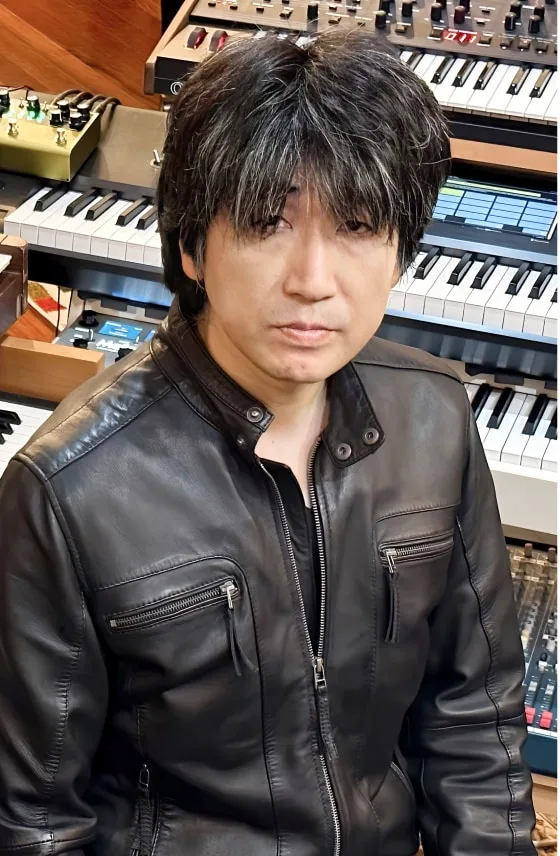
From Progressive-Rock Keyboardist to a Cross-Generational JRPG Composer
Motoi Sakuraba is a Japanese composer, arranger and keyboardist. Since joining Wolf Team, a division of Telenet Japan, at the end of the 1980s, he has maintained long associations with the Tales, Star Ocean, Valkyrie Profile, Golden Sun, Mario Golf, Mario Tennis, Baten Kaitos and Dark Souls series. His career spans computer and console sound chips, streamed audio, band recording, orchestral production and live performance, tracing a continuous path through the technological development of Japanese game music.
Profile
- Japanese name: 桜庭 統
- Born: August 5, 1965
- Birthplace: Akita Prefecture, Japan
- Occupations: Composer, arranger, keyboardist
- Active: Mid-1980s to present; game-music work from 1989
Early Years: From Electone to DEJA-VU
Sakuraba began studying electronic organ at three and moved to piano about two years later. In interviews, he has recalled that faithfully repeating a score never came naturally: he would alter phrases himself and was already attempting improvisations close to composition in primary school. Film soundtracks collected by his elder brother, Beethoven, Isao Tomita's synthesizer music and his own encounter with synthesizers in junior high formed the foundations of his listening life.
At school he combined sports with band activity. He played keyboard in hard-rock bands during high school; at university, he joined a rock-centered music club and formed the progressive-rock band DEJA-VU. He has cited UK, King Crimson, Deep Purple, film scores and instrumental music among the influences on his writing and performance.
DEJA-VU released the studio album Baroque in the Future in 1988. Centered on keyboards, the record combines organ, synthesizer, piano, complex rhythms and extended instrumental development. The band ended around 1989, but the logic of the keyboard trio, progressive rock's long-form movement and the consciousness of live performance remained embedded in Sakuraba's game scores and solo work.
Wolf Team: Entering Game Sound Production
After university, Sakuraba sustained his musical activity with live and recording work, but progressive rock did not provide a stable living. At about twenty-four, he answered an advertisement for a game-company musician, sent Wolf Team a demo of the styles he played best and was hired. He later recalled that he did not own a console and knew almost nothing about “game music”; Wolf Team was the only game company to which he applied.
He first learned Recomposer entry on the PC-98. His first month focused on sound effects before he moved into background music. A common early setup offered only three PSG parts and two FM parts, while sound effects could seize and interrupt one of the musical voices. Composition therefore meant continuously reallocating scarce resources among melody, harmony, rhythm and effects, and coordinating channel and memory limits with programmers.
Zan: Kagerou no Toki, Granada and Sol-Feace are representative early credits. Hardware limits demanded identity through clear melodies, compact motifs and careful voicing. Sakuraba later argued that chip music was not merely an inferior stand-in for modern high-resolution audio; it was an autonomous form defined by the timbre of its hardware era. The first PlayStation expanded sampling and onboard sound, while PlayStation 2 made streamed background music commonplace. His work accordingly moved from personal tone creation and chip programming toward a production environment where live instruments, bands and orchestras could coexist.
From Staff Composer to Long-Term Freelance Collaborator
From the mid-1990s, Sakuraba worked independently and built lasting relationships with tri-Ace, Camelot, Namco and later Bandai Namco, tri-Crescendo, FromSoftware and Nintendo-related projects. Rather than appearing for only a handful of tracks, he often remained with a series across generations, binding his musical language to its collective memory. Many of these games were collaborative productions involving other composers, arrangers, audio directors, orchestrators and recording teams; individual track attribution should always follow game credits, soundtrack booklets and rightsholder documentation.
Long-Running Series
Tales
Tales of Phantasia (1995) was a major career landmark and the beginning of Sakuraba's long association with Tales. Bandai Namco's series retrospective names him as one of the composers who helped establish its musical foundations from the earliest entries. He subsequently contributed to Tales of Destiny, Tales of Eternia, Tales of Symphonia, Tales of Vesperia, Tales of Berseria, Tales of Arise and many others.
Battle music is the most immediately recognizable part of that work, but his remit also covers locations, dungeons, characters and drama. Early scores were constrained by Super Famicom and PlayStation sound hardware; later titles gradually adopted streamed audio, live instruments and larger orchestral forces. Across that span, Sakuraba retained elements of his rhythmic and keyboard vocabulary while repeatedly adapting its timbre and production scale.
Star Ocean and Valkyrie Profile
Sakuraba has scored tri-Ace titles since the first Star Ocean in 1996 and wrote the music for Valkyrie Profile in 1999. Star Ocean's fusion of science fiction and fantasy accommodates synthesizers, rock rhythm sections, piano and orchestra within the same score. Valkyrie Profile's Norse mythology, death-centered drama and combat design elicited a sound with stronger ritual, tragedy and progressive-rock momentum.
STAR OCEAN THE SECOND STORY R (2023) demonstrated the continuity of that relationship. Sakuraba completely rearranged the original music, added new tracks and recorded parts of the battle score with a live band. It was not a simple reuse of old assets, but a reconstruction that preserved melodic memory through contemporary timbre and performance.
Camelot, Nintendo and Handheld Hardware
Sakuraba has also worked extensively on Camelot's Mario Golf, Mario Tennis and Golden Sun series. The sports games must respond to turns, scores and shifts of pace, while Golden Sun constructs a large RPG on the Game Boy Advance's limited voices and portable speakers. In a 2023 interview he recalled that an early handheld might provide only three or four simultaneous sounds. Timbre alone could not carry the score; a melody or riff had to register almost immediately.
Baten Kaitos and Eternal Sonata
Baten Kaitos: Eternal Wings and the Lost Ocean (2003), Baten Kaitos Origins (2006) and Eternal Sonata (2007) widened his palette further. Baten Kaitos had to connect a floating world, card-based combat and fantasy narrative; Eternal Sonata built its premise around Frédéric Chopin and Romantic music. Piano, strings, organ, synthesizer and rock rhythm are not a fixed Sakuraba formula: each project redistributes them according to its subject. Eternal Sonata in particular places classical piano language beside modern combat scoring, seeking an interface between a historical musical image and the timing of game action.
Dark Souls: From Dense Drive to Restrained Dark Orchestration
Sakuraba composed for Dark Souls (2011) and continued on selected music for Dark Souls II and Dark Souls III. Exploration often relies on ambience and silence, concentrating music in boss battles and crucial scenes; every entrance therefore carries unusual narrative weight.
His Dark Souls music combines choir, strings, brass, percussion and piano, yet does not pursue maximum volume in every scene. “Gwyn, Lord of Cinder” replaces the expected endgame orchestral mass with a comparatively spare piano texture. It shows how he can establish tragedy through repetition and subtraction outside his denser progressive-rock vocabulary. A widely repeated online claim says that the white-key writing symbolically corresponds to Gwyn's name, but no formal explanation by Sakuraba or FromSoftware has been identified; it should not be treated as confirmed intent.
Writing and Sound-Design Characteristics
Progressive Rock and Keyboard-Centered Form
Sakuraba's most recognizable pieces commonly organize themselves around keyboards: rapid piano or synthesizer lines, organ timbre, shifting metric emphasis, dense bass and drums, and the motivic development of classical music. Fans sometimes call this the “Sakuraba style,” but the label describes only part of his high-speed battle writing, not his entire range.
His experience as a performer makes many phrases feel physically playable. The keyboard trio is especially important. Without a guitar continuously filling the midrange, the keyboard can handle melody, harmony, timbral change and improvisational development at once, while bass and drums engage in a more oppositional rhythmic relationship.
Melodic Priority Under Hardware Limits
When early hardware could not hold elaborate timbre or many voices, melody and riff had to do more identifying work. Sakuraba does not treat those limits merely as defects: the grain, envelopes and small voice counts of PC, Super Famicom and Game Boy Advance hardware are aesthetic materials of their own period. Modern constraints have moved toward picture timing, recording budgets, schedules, loop length and team coordination. His professional problem has therefore shifted from choosing within a few channels to preserving the right proportion between music and image amid abundant resources.
Serving the Image and the Player's State
Sakuraba usually reads a script quickly to absorb world, character background, objectives and art direction rather than exhaust every detail before composing. He has explained that too much information can narrow his imagination; for cinematic scenes, he instead scores directly and precisely to picture.
He also argues that game music should neither become imperceptible wallpaper nor detach from the image through overassertive melody and personality. As games become more realistic, that balance grows harder. Music must move story and player emotion while remaining subordinate to the game itself.
Commissioned Games and Personal Music
For Sakuraba, game music is first a component of a larger work. Style and function are shaped by requests, revisions and implementation constraints. A solo album places music itself at the center and offers a freer, performer-led mode of creation. He has also stated that he is not a game player and seldom builds references by listening broadly to other game scores; his work proceeds from specifications, world, character, art and communication with the development team.
Solo Albums and Live Performance
Alongside games, Sakuraba has steadily released personal music. DEJA-VU's Baroque in the Future, his 1991 debut solo album Gikyokuonsou, the piano- and keyboard-focused Forest of Glass, and albums including After all..., What's Up? and Passage form a creative line outside specific game scenes. Reissues in 2023 made it possible to hear his progressive-rock origins beside the game writing that followed.
Live performance remains central to his professional identity. He has staged solo and game-music concerts and performed on keyboard in projects including Linked Horizon. Sakuraba calls live music his “root,” viewing continued performance as a way to sustain his composing condition.
Recent Activity
Sakuraba continues to move between new games and reconstructions of older music. He joined the ensemble of composers on Eiyuden Chronicle: Hundred Heroes in 2024. The mobile RPG 名もなき者の詩 昔懐かしきドット絵RPG, launched in Japan on July 29, 2025, also features his music. In an interview for the project, he said mobile games must seize attention quickly, so he prioritizes melodies that register at once and uses relatively light rhythm and timbre to balance the gravity of a Norse-mythology setting.
Two new solo albums, Philosophical Return and Emotional Mind, will be released together on November 4, 2026. The former centers on a keyboard trio of Sakuraba, bassist Atsushi Hasegawa and drummer Yoshinori Imai, using instruments including Hammond C3, KORG CX-3, Minimoog, Prophet-10, Mellotron and acoustic piano. The latter places synthesizers, drum machines and electronic sound further forward. Together, the albums represent the live-band and synthesizer paths that have run through his career. Sakuraba remains active as an independent composer and keyboardist, with Scarlet Moon Artists providing an international contact point for game composition, arrangement and live performance.
Selected Works
This chronological selection is not a complete discography. Many entries are collaborative projects; game credits and soundtrack documentation remain the authority for individual tracks and roles.
- 1989 — Zan: Kagerou no Toki
Early game-music work - 1990 — Granada; Sol-Feace
Wolf Team scores - 1995 — Tales of Phantasia
Beginning of his long Tales association - 1996 — Star Ocean; Shining the Holy Ark
Composer - 1997 — Shining Force III; Tales of Destiny
Composer / collaborative project - 1998 — Star Ocean: The Second Story
Composer - 1999 — Valkyrie Profile; Mario Golf
Composer - 2000 — Tales of Eternia; Mario Tennis
Composer / collaborative project - 2001 — Golden Sun
Composer - 2002 — Tales of Destiny 2; Golden Sun: The Lost Age
Composer - 2003 — Star Ocean: Till the End of Time; Baten Kaitos: Eternal Wings and the Lost Ocean; Tales of Symphonia
Composer - 2006 — Valkyrie Profile 2: Silmeria; Baten Kaitos Origins
Composer - 2007 — Eternal Sonata
Composer - 2008 — Infinite Undiscovery; Tales of Vesperia; Super Smash Bros. Brawl
Composer / arranger - 2009 — Star Ocean: The Last Hope; Tales of Graces
Composer - 2010 — Resonance of Fate; Golden Sun: Dark Dawn
Co-composer / composer - 2011 — Dark Souls
Composer on selected tracks - 2012 — Kid Icarus: Uprising; Beyond the Labyrinth
Team composer / composer - 2014 — Dark Souls II; Phantasy Star Nova; Super Smash Bros. for Nintendo 3DS and Wii U
Selected composition / arrangement - 2016 — Dark Souls III; Tales of Berseria; Star Ocean: Integrity and Faithlessness
Selected composition / composition - 2018 — Mario Tennis Aces; Super Smash Bros. Ultimate
Composer / arranger - 2021 — Tales of Arise; Mario Golf: Super Rush
Composer - 2022 — Star Ocean: The Divine Force; Valkyrie Elysium
Composer - 2023 — STAR OCEAN THE SECOND STORY R
Complete rearrangement of the original score plus new music - 2024 — Eiyuden Chronicle: Hundred Heroes
Co-composer - 2025 — 名もなき者の詩 昔懐かしきドット絵RPG
Music production / composition
Selected Track Guide
- FINAL ACT — Tales of Phantasia
- FOR ACHIEVE — Star Ocean
- Stab the sword of justice — Star Ocean: The Second Story
- The incarnation of devil — Star Ocean series
- 未確認神闘シンドローム — Valkyrie Profile
- Confidence in the domination — Valkyrie Profile
- 立ちはだかる宿敵 — Golden Sun series
- ゲームポイント・ブレークポイント — Mario Tennis 64
- The true mirror — Baten Kaitos: Eternal Wings and the Lost Ocean
- The valedictory elegy — Baten Kaitos Origins
- Leap the precipice — Eternal Sonata
- Gwyn, Lord of Cinder — Dark Souls
Sources
- Motoi Sakuraba official website: profile and 2026 solo-album announcement.
- AV Watch long-form interview: early musical life, Wolf Team, sound hardware and contemporary production.
- SPICE interview: influences, early games, scoring to picture and live performance.
- OTOTSU interview: commissioned game music, personal work, handheld limitations and reissues.
- Scarlet Moon Artists: international representation and selected credits.
- Bandai Namco FUNFARE's 25th-anniversary Tales retrospective.
- Square Enix Music's Star Ocean soundtrack catalog.
- Dengeki Online interview on 名もなき者の詩.
- OTOTSU: announcement of Sakuraba's two 2026 solo albums.