
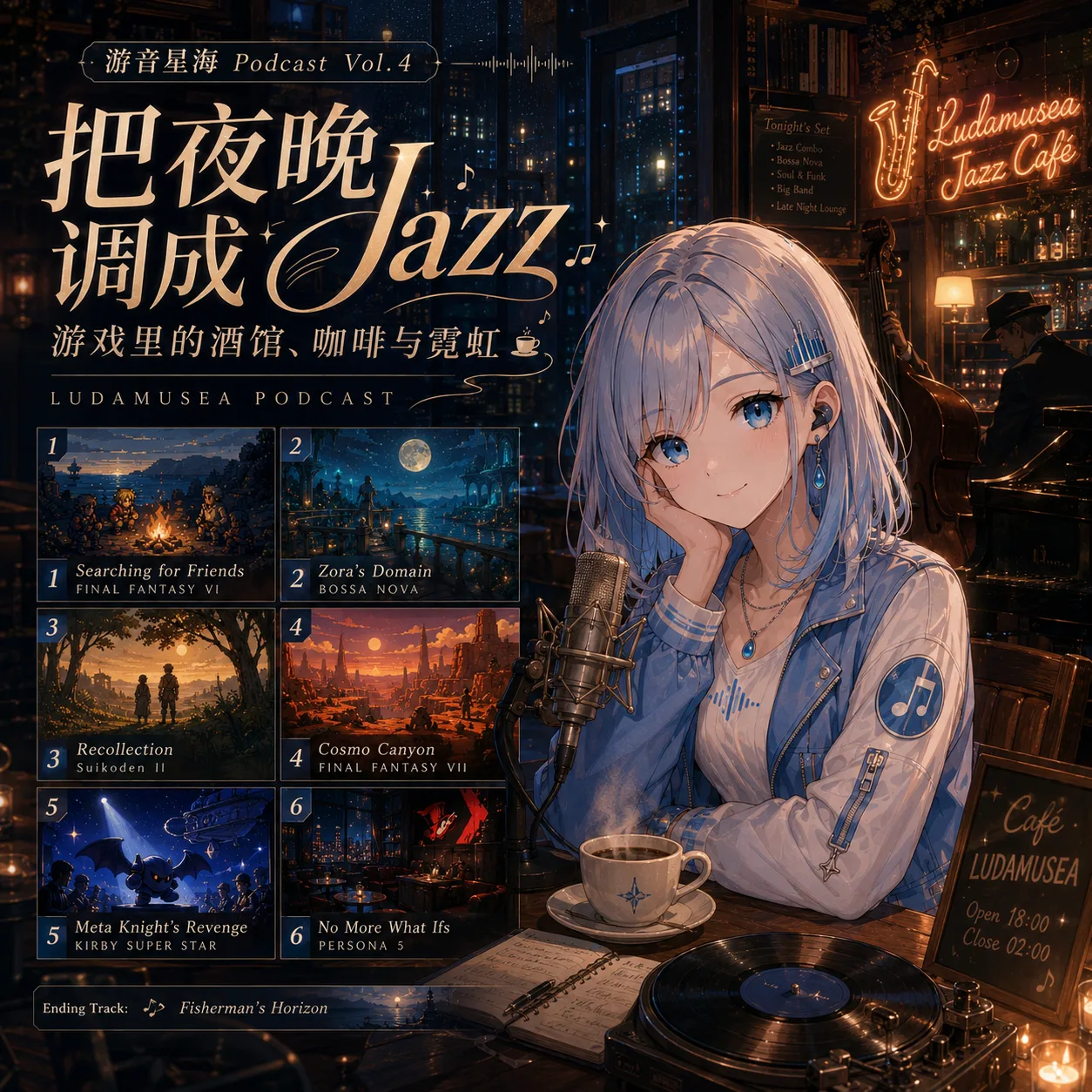
About this episode
This episode treats jazz as more than a list of styles. Six pieces trace a late-night café from the moment its doors open to closing time: the city slips into night, a seaside breeze passes the window, conversation draws closer, and the musicians suddenly let loose. After the bustle fades, one person remains with questions that have no answers.
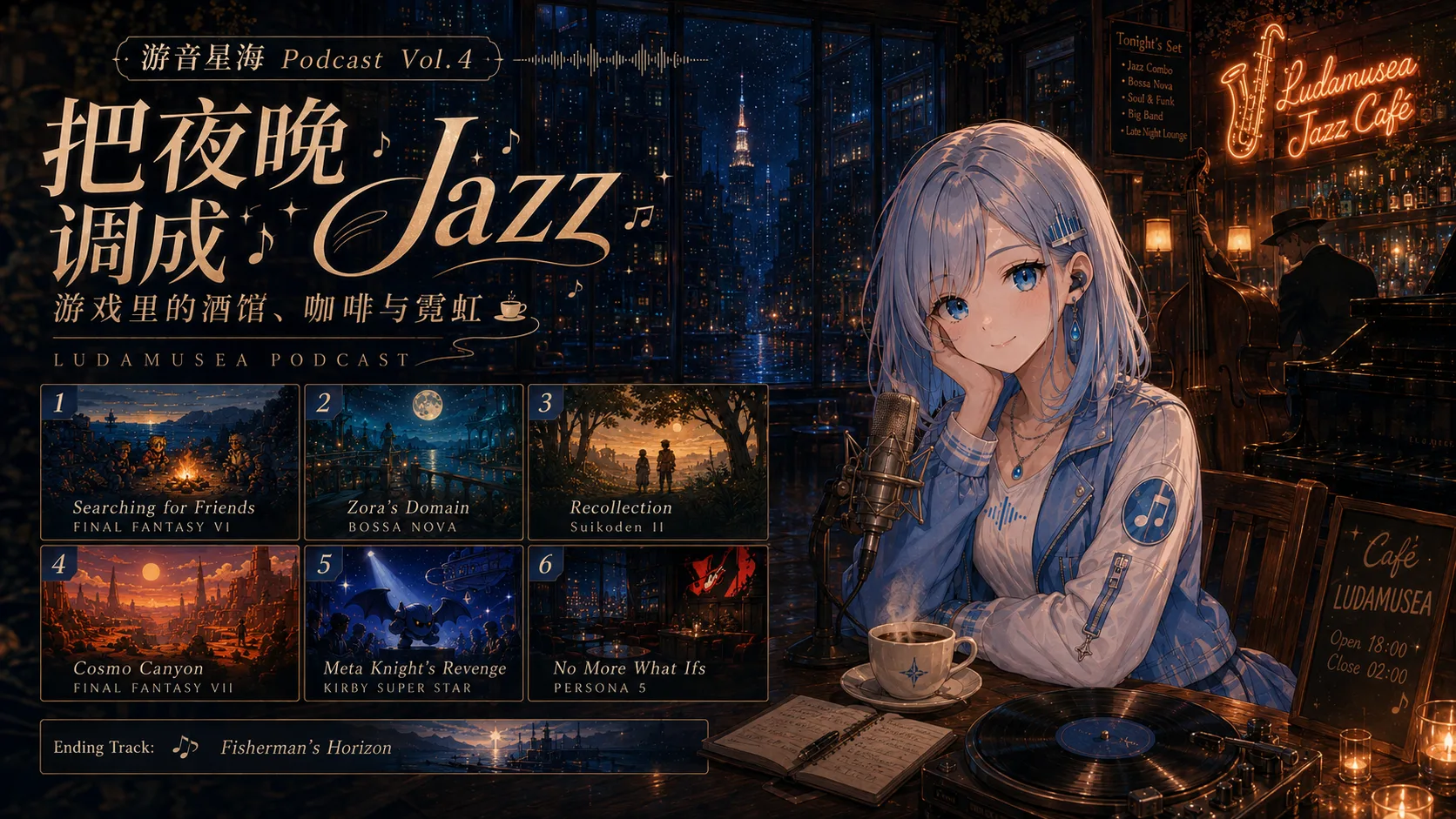
Tonight, there’s no hurry to go home. Let familiar melodies find another way to speak in the light.
This episode discusses important character developments in FINAL FANTASY VI, Suikoden II and FINAL FANTASY VII, including the story of Nanaki and his father Seto at Cosmo Canyon.
Tonight’s route
- City after dark | Searching: Searching for Friends — Jazz Arrangement
- Seaside coffee | Unwinding: Zora’s Domain — Chjolo’s Bossa Nova Remix
- A private conversation | Drawing closer: Recollection
- The groove warms up | Release: Cosmo Canyon — Jazz Arrangement
- The big band takes the stage | Letting loose: Meta Knight’s Revenge
- The night winds down | Accepting the unknown: No More What Ifs ft. Martina DaSilva
Episode manuscript
Opening | After the door opens
Good evening. I’m Calia.
If you’re on your way home, there’s no need to walk too quickly. Tonight, let’s take a little detour through the city.
Imagine the streetlights have just come on. Behind a glass door, a small lamp glows warmly. The door handle is a little cold, and from inside come the sounds of brushed drums, an upright bass, and a few phrases of a melody you know you’ve heard before, though its name escapes you. You open the door, leaving the wind behind. Someone looks up at you, then goes back to playing the piano.
Tonight, there’s no hurry to go home. Let’s tune the night to Jazz.
This isn’t a lesson in jazz styles, or a display of six songs. The music ahead will keep us company through an entire evening in a late-night café, from opening the door to closing time: first finding a seat, then letting our shoulders relax; saying a few things to someone that we haven’t said in a long while; waiting for the musicians to warm the air; and finally watching the crowd disperse, accepting that some ‘what ifs’ may never have an answer.
Our first song begins with searching. On many nights, we don’t open a door because we already know our destination. We’ve simply been walking for a long time, and at last we hear someone playing inside.
01 City after dark: still searching
In FINAL FANTASY VI, the world really has been shattered. The map has changed, familiar people are scattered in different places, and the party that once fought side by side no longer stands together as a matter of course. ‘Searching for friends’ is therefore more than an elegant theme. It is something very concrete: you must set out again and ask each person—are you still willing to come back?
There is a forward-driving force in the original piece. It knows the road ahead is long, but it doesn’t stop to mourn for too long. In this jazz version, drums, upright bass, piano and guitar bring that force into a small room. There is no great wall of brass announcing a hero’s return—just four musicians listening to one another and taking turns catching the melody.
I love that change. As we grow older, ‘searching for friends’ often means neither crossing a continent nor gathering everyone aboard the same airship again. It may simply mean sending a message to someone you haven’t spoken to for a long time: how have you been? Or it may mean finally admitting, at the most chaotic moment in your own life—I actually need someone beside me.
True companions don’t necessarily repair the world for you. Sometimes, they simply let you know that, after the world has changed, you don’t have to learn your way around it again alone.
The door is open now. Don’t hurry to find the quietest corner. Let this song lead you through the city as its lights come on, and see who else is walking toward you beneath the same night sky.
02 Seaside coffee: the water remembers the way back
Only after we find a seat does the night really begin.
Our second piece is the Bossa Nova Remix of ‘Zora’s Domain’. If you know The Legend of Zelda, you may first think of flowing water, blue light, and a domain that seems to have been sculpted by the river itself. But even if you’ve never been there, it’s easy to hear a sense of space in this guitar: not a tightly enclosed tavern, but a table beside a window, with water outside and moonlight moving slowly across its surface.
Bossa nova fits this moment beautifully. Its beat doesn’t hurry you; it gently supports your body. The first piece was still moving forward, but this one feels as though someone has pulled a chair back a little and said: that’s enough for now. Sit down first.
The waterside places in games often feel special. We leave them, travelling somewhere more dangerous and more distant, yet when the melody returns, our bodies recognise it before our memories do. Perhaps a ‘place we can return to’ isn’t a set of coordinates that never changes, but a rhythm—one that, when it arrives, finally frees us from having to explain why we’re tired.
Some places won’t solve your problems for you. They simply let you hear your own breathing again before you set out once more.
Now, set your cup within reach. The water outside the window is still moving, but for this little while, you don’t have to.
03 A private conversation: three children who thought they would never part
As the night grows deeper, the conversation at the table changes too. When we first meet, we talk about work, the weather, and the games we’ve been playing lately. But as the ice in our glasses slowly melts, names we haven’t touched for a long time may suddenly find their way into a sentence.
‘Recollection’ from Suikoden II speaks to just such a backward glance. Riou, Jowy and Nanami once shared a very simple time. They grew up together, believing they would always stand on the same side. But when war came, their choices could no longer be reduced to ‘shall we go together?’ The future each of them saw began to lead in a different direction.
This version of ‘Recollection’ doesn’t tell the story of parting on a grand scale. The piano places the melody close to us, and the flute responds softly, like another person. It doesn’t seem to ask who was right and who was wrong. It feels more like two people finally sitting down years later, acknowledging that those days really existed, and that neither of them ever emerged from them completely.
We tend to think that cherishing a relationship means restoring it to the way it used to be. But some people enter our lives without being meant to remain in the same place forever. They teach us trust, betrayal and forgiveness, and let us discover for the first time that people who love each other can still choose different paths.
Remembering someone doesn’t mean you have to return to that relationship. Sometimes, memory simply keeps a seat for who we once were.
If someone comes to mind for you tonight, there’s no need to rush toward a conclusion about that memory. Let the piano finish what it has to say, and let the flute sit beside it for a while. Drawing closer doesn’t always mean having someone back. It can also mean finally being willing to see them clearly.
04 The groove warms up: turning silence into firelight
After some words are spoken, the room doesn’t immediately grow quiet. Instead, like fire meeting air, it suddenly brightens a little.
‘Cosmo Canyon’ belongs to the place of the same name in FINAL FANTASY VII. For Nanaki, it is no ordinary stopping point. It is home, and a place he has long refused to face. He once believed his father, Seto, had fled in a moment of crisis, and carried that shame for many years. Only later did he learn that his father had never left. Seto remained deep within the canyon, defending his home even after he had turned to stone.
The original music already carries the power of earth, fire and ancient ritual. The jazz arrangement doesn’t smooth those qualities away. Instead, it pushes them into a groove you feel more physically. The electric guitar grows sharper, the bass moves forward, and the instruments answer one another as though gathered around a fire. The sorrow hasn’t disappeared; it simply no longer lies flattened on the ground.
I often feel that learning the truth doesn’t necessarily bring immediate relief. You still have to understand your former self all over again: where should you put those years of anger, misunderstanding and refusing to look back? But at least the truth gives your strength back to you. It frees you from continuing to pay for a story that was never true.
Some wounds don’t disappear just because they’ve been explained. But when you finally know who has been protecting you all along, silence can become firelight again.
Now the lights on the little stage are on. Let the drums and bass pull us up out of our memories. Not to forget what just happened, but to let the body complete a release on the heart’s behalf.
05 The big band takes the stage: a room that catches your melody
If the fourth piece is the moment the musicians begin to let loose, the fifth is when the whole café finally moves its tables and chairs a little to the side.
‘Meta Knight’s Revenge’ comes from Kirby Super Star. In the original game sequence, Kirby boards the battleship Halberd as time counts down. Machinery, alarms and the chase push everything forward at speed. The music is inherently dramatic, and inherently suited to being made larger.
The 8-Bit Big Band’s version does more than dress the melody in a magnificent new coat. What is truly compelling about a big band is that so many people must hear one another at the same time: the brass raises the theme high, the rhythm section keeps driving beneath it, and the soloist steps forward before handing the space back to the whole ensemble at just the right moment. Button Masher’s electronic performance doesn’t hide the game sounds away to make them seem more ‘grown-up’. Instead, it puts them on the same stage as the band.
The arrangement later won a Grammy, but the reason to remember it is more than ‘game music won an award too’. More significant is that a melody which once came racing out of a console’s speakers was carefully taken apart, answered, and offered back to listeners by so many performers working together. It didn’t lose the speed of childhood as it grew up, and it didn’t stand still in nostalgia either.
Real liveliness isn’t everyone making the loudest possible sound. It is the whole room knowing how to catch your melody when it appears.
Let tonight’s brightest light belong to this piece. Enjoy it fully. When the last note falls, we’ll return to our own seats.
06 The night winds down: what ifs that need no answer
After the big band finishes, the café suddenly seems very large. Cups are cleared away, and the lights on the stage dim one by one. Just a moment ago, everyone’s voices were here. Now there is only you and your reflection in the window.
In Persona 5 Royal, ‘No More What Ifs’ already belongs to a jazz bar. It is in no hurry to advance the adventure or make anyone’s decisions for them. It simply places a very adult, very private question on the table: if I had taken another path back then, would the person I am now be different?
Of course, we can list plenty of answers. Changing jobs, not leaving that city, saying ‘I like you’ sooner, or choosing to stay on a particular night. But the most unusual thing about a ‘what if’ is that it looks like a door, yet when you really push it open, there is no room you can examine. That other life exists only in the imagination, so it is always more complete than reality, and never has to bear reality’s cost.
Martina DaSilva’s singing and The 8-Bit Big Band’s new arrangement don’t turn the question into an immense regret. It feels more like looking toward the stage one last time before closing: a little reluctance to leave, along with the ease of finally no longer demanding an answer. Accepting the unknown doesn’t mean saying that every choice in the past was right. It simply means acknowledging that the person you are today can only keep living from here.
The night is already deep. We always wonder whether things would be different now if we had chosen another road then. But tonight, we don’t need an answer. Some questions only need the quiet company of a song.
Thank you for coming to this late-night café at Ludamusea. I’m Calia. When you leave here, I hope you won’t feel you have to hurry to become someone else.
The wind is still outside the door. Walk a little more slowly. Next time, we’ll meet again in game music.
After hours | One last light for those still awake
The main programme has already said good night. This song is for anyone who isn’t ready to fall asleep just yet.
‘Fisherman’s Horizon’ takes on no new narrative task. It isn’t a seventh chapter, and it doesn’t need Calia to explain the theme again. It simply lets the saxophone and piano keep talking in the room after it has emptied—like a small patch of moonlight left on a table after the staff switch off the sign.
If the first six pieces lead us from searching to accepting the unknown, this one simply returns our bodies safely to the night. You can keep listening, or fall asleep between any two phrases.
Episode selections
- Searching for Friends — Jazz Arrangement | FINAL FANTASY VI; original music: Nobuo Uematsu; arrangement: Eijiro Nakagawa; album: SQUARE ENIX JAZZ -FINAL FANTASY-.
- Zora’s Domain — Chjolo’s Bossa Nova Remix | The Legend of Zelda series; produced by Chris Logsdon (Chjolo); released by GameChops.
- Recollection | Suikoden II; original music: Miki Higashino; sound producer: Kentaro Haneda; arrangement: Michiru Oshima; piano: Hiroko Kokubu; flute: Rie Akagi. Appears on Genso Suikoden Music Collection Produced by Kentaro Haneda and Smooth Jazz Living 01.
- Cosmo Canyon — Jazz Arrangement | FINAL FANTASY VII; original music: Nobuo Uematsu; album: SQUARE ENIX JAZZ -FINAL FANTASY VII-.
- Meta Knight’s Revenge | Kirby Super Star; performed by The 8-Bit Big Band feat. Button Masher; arranged by Charlie Rosen and Jake Silverman; album: Backwards Compatible. The arrangement won Best Arrangement, Instrumental or A Cappella at the 64th GRAMMY Awards, with the award going to its two arrangers.
- No More What Ifs ft. Martina DaSilva | Persona 5 Royal; original music: Shoji Meguro; performed by The 8-Bit Big Band; vocals: Martina DaSilva; album: Orchestrator Emulator.
- After hours: Fisherman’s Horizon — GENTLE LOVE | FINAL FANTASY VIII; arranged and performed by GENTLE LOVE; saxophone: Norihiko Hibino; piano: AYAKI; album: Prescription for Sleep: Game Music Lullabies, Vol. I (Remastered Version).
Episode information
- Programme: Starsea Podcast EP.04
- Theme: Tune the Night to Jazz — Taverns, Coffee and Neon in Games
- Subtitle: Six scenes in a game-music jazz night, from opening the door to closing time
- Host: Calia
- Guests: No guest this episode
- Duration: 34:52
- Release date: October 1, 2026
Sources
- SQUARE ENIX JAZZ -FINAL FANTASY- — SQUARE ENIX MUSIC
- Zora’s Domain — Chjolo / GameChops
- Genso Suikoden Music Collection Produced by Kentaro Haneda — VGMdb
- Genso Suikoden Music Collection Produced by Kentaro Haneda — Tower Records
- Smooth Jazz Living 01 — Billboard Japan
- SQUARE ENIX JAZZ -FINAL FANTASY VII- — SQUARE ENIX MUSIC
- 64th GRAMMY Awards — Recording Academy
- The 8-Bit Big Band — Official
- Orchestrator Emulator — The 8-Bit Big Band / Bandcamp
- Prescription for Sleep: Game Music Lullabies, Vol. I (Remastered Version) — Scarlet Moon Records / Bandcamp
All games, music and sound recordings discussed in this episode remain the property of their respective rights holders. This programme is presented for game-music commentary, introduction and research discussion.