
About this episode
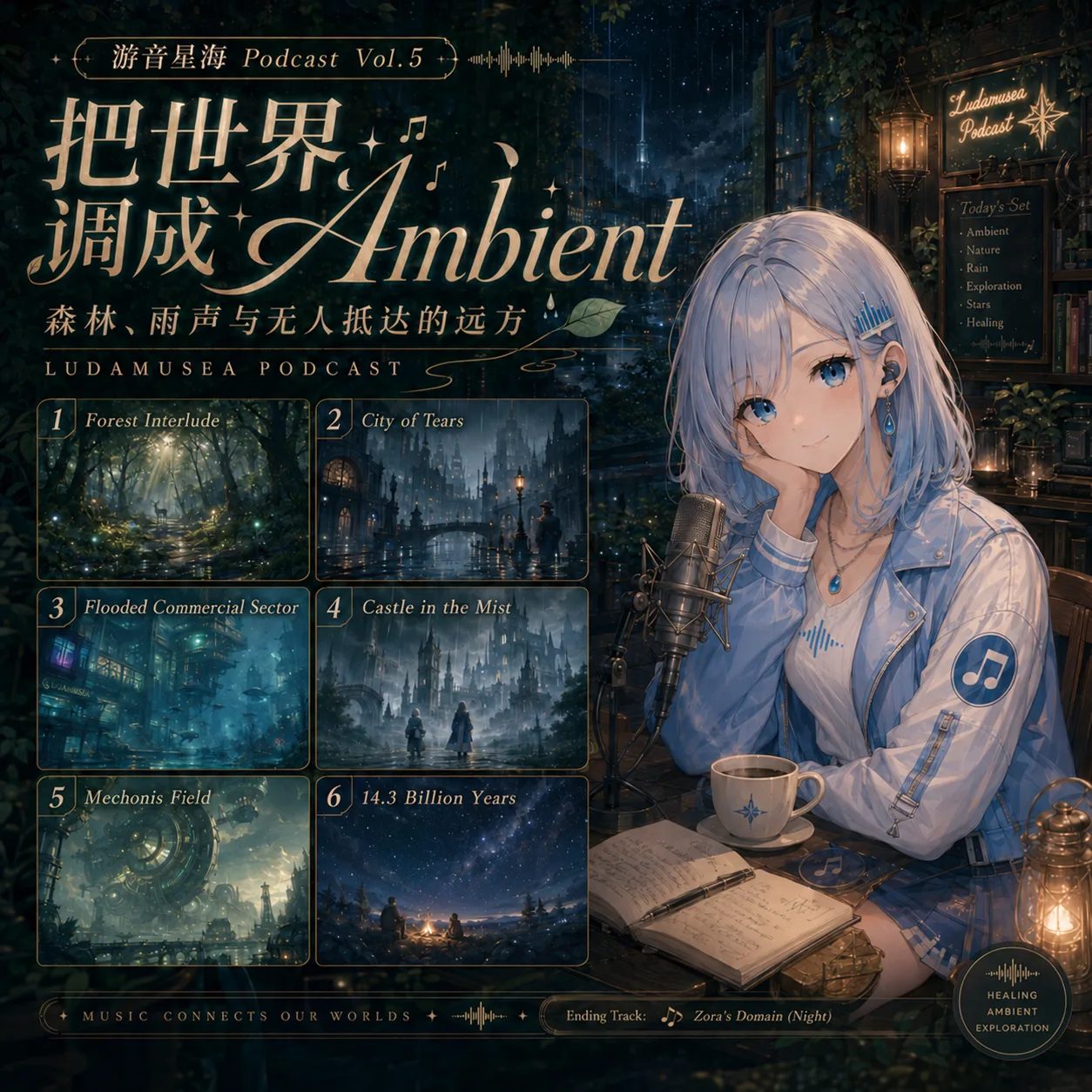
In the first four episodes, we often followed a melody towards a person, a relationship, or a late-night café. Vol.5 pulls the camera back a little further. Rather than rushing to ask what the main character is thinking, we listen to forests, a rain-soaked city, underwater ruins, a castle in the mist, a mechanical landscape, and the universe itself.
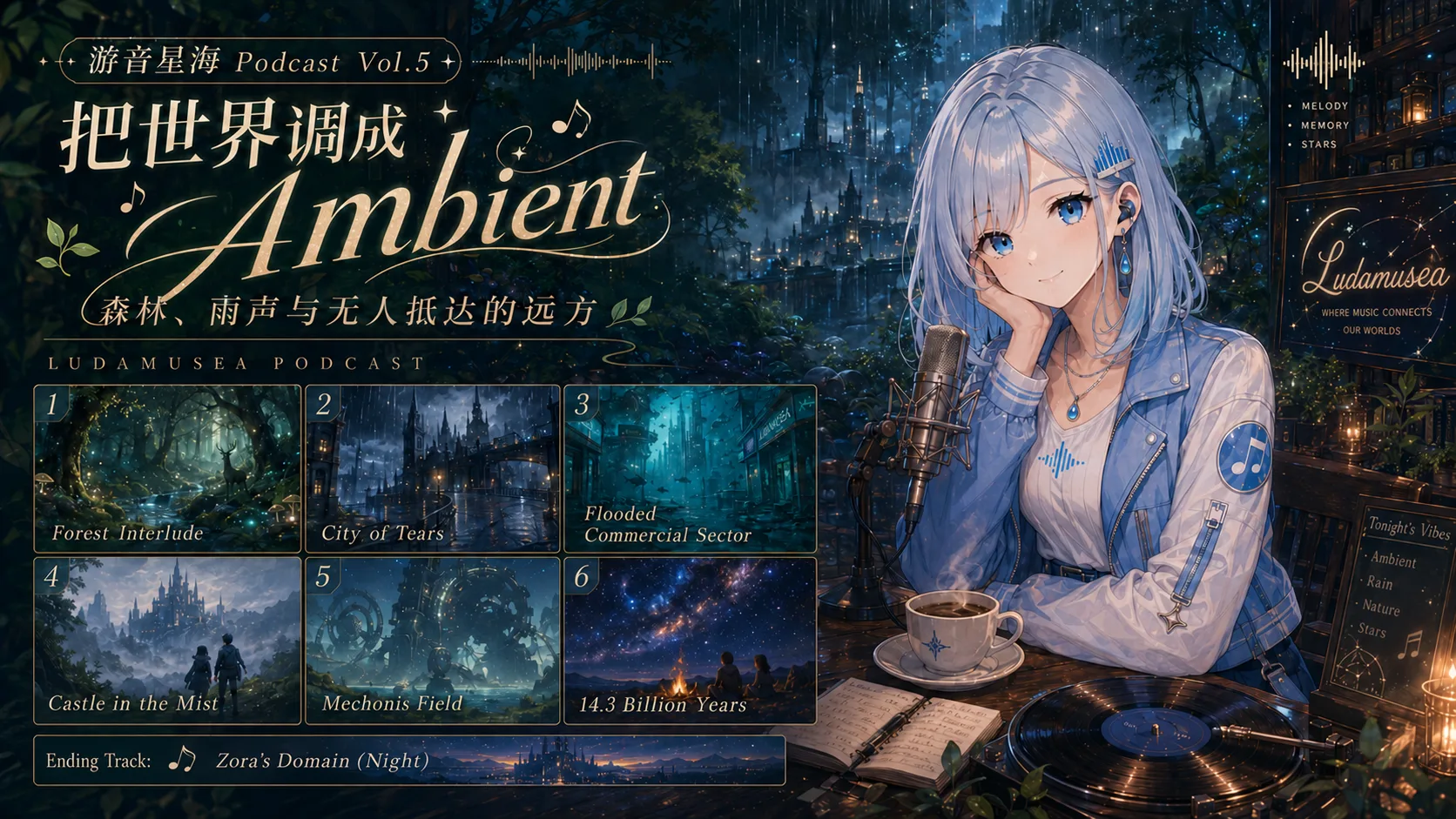
Some worlds keep raining, breathing, and slowly moving towards tomorrow without waiting for us to arrive.
Spoiler warning: the sixth section discusses major ending imagery from Outer Wilds, including travellers, a campfire, the end of the universe, and new life.
Tonight’s route
- The forest breathes | Forest Interlude
- A city of tears | City of Tears
- Civilisation underwater | Flooded Commercial Sector
- Together in the mist | Castle in the Mist
- A mechanical pulse | Mechonis Field
- A universe reborn | 14.3 Billion Years
Episode manuscript
Opening | Hearing a world without its player
Good evening. I’m Calia.
Tonight, let’s take our time before looking for the story’s main character. Tread a little more softly, and listen to the places where nobody is speaking.
There is a forest whose leaves sway slowly inside a very old console; a city whose streets cannot see the sky, yet where rain never stops falling; flooded shopping centres, castles in the mist, and an entire world made of machinery. They do not vanish the moment the player puts down the controller. At least in the music, the wind still passes through, the water still rises, and enormous gears keep turning in the dark.
Good environmental music does more than tell us where we are. It makes us believe that, long before we arrived, this world had already been living for a very long time.
The next six pieces will take us from the forest to the end of the universe. Calia will be waiting only where the paths divide. At other times, let the world speak for itself.
01 The forest begins to breathe | Forest Interlude
Our first stop is Forest Interlude from Donkey Kong Country 2: Diddy’s Kong Quest.
A forest from the 16-bit era could not, of course, preserve an entire landscape of wind, a whole population of insects, or the light between the treetops. Yet with synthesised timbres, David Wise left us a remarkable illusion: the lower sounds feel like damp soil, the melody descends slowly from above, and somewhere in the distance, living things we cannot quite name are moving.
This is not simply a level with a few trees placed in the background. The music gives the forest a time of its own. The player may run, fail, and start again, but the trees do not speed up to match our anxiety. The forest simply keeps breathing.
I like beginning with this piece because true exploration does not always start with the question, ‘Where am I going?’ Sometimes it begins with a discovery: the place I am in is larger than I am, and will outlast the questions I bring to it.
The forest has not prepared answers for us. With its own breathing, it simply reminds us that we too can slow down and become part of the world again.
Now, follow the shadows of the trees. There is no hurry to identify every sound. First, let the forest know we have arrived.
02 Rain falls on a city | City of Tears
After leaving the forest, we arrive in a city that cannot see the sky.
In Hollow Knight’s City of Tears, rain falls ceaselessly from the waters above. A once-prosperous kingdom has fallen silent. Platforms, benches and tall windows remain, but few can explain what happened here. The city says nothing. It simply keeps raining.
Christopher Larkin’s piano leaves space between the raindrops. Amelia Jones’s soprano does not speak specific lines on behalf of any character; it feels more like a shaft of light rising from deep within the buildings. Here, the voice is not one particular person. It is the memory the whole city still holds.
We often understand rain as sadness. Yet rain can also bring sounds closer: the eaves, the stone streets, our own footsteps. For a while, it reduces an enormous city to the space within our hearing.
Some cities seem to be crying. Perhaps they are simply using rain to preserve stories from long ago, over and over again.
Find a bench sheltered from the rain. Sit for a while. We need not make the rain stop falling on this city.
03 Civilisation sinks underwater | Flooded Commercial Sector
The rain keeps travelling downward, until it floods an entire commercial district.
Flooded Commercial Sector from Stellar Blade confronts a very modern kind of ruin. This place once belonged to lights, shop windows, passageways, and desires that were constantly being renewed. But when the crowds leave and the water enters, all those instructions—‘Look here,’ ‘Buy this,’ ‘Keep moving’—lose the people they were addressed to.
Oliver Good’s music does not portray the ruins as merely frightening. Its slow beat and floating voices allow the space to retain a little beauty, even a little tenderness. This is not because destruction deserves to be romanticised, but because time has begun rearranging humanity’s rooms.
Water is impartial. It passes expensive signs as well as stairways nobody claims. It turns the places that were once the loudest into spaces we must hold our breath to enter.
Only when a city no longer needs to attract anyone does it reveal its true silence for the first time.
We pass beneath the surface and take nothing away. We only look at the things once considered indispensable possessions, and watch them slowly lose their names in the light on the water.
04 Two people cross a castle in the mist | Castle in the Mist
After the water recedes, a castle surrounded by mist lies ahead.
In ICO, the castle is vast and empty. Many of its rooms seem to have existed longer than the people inside them. Ico and Yorda do not share quite the same language. They cannot know where each door ahead will lead, yet again and again, they must reach out a hand.
Many games ask us to prove a bond through combat. ICO places that bond in the simplest actions: waiting, looking back, checking whether the other person has kept up. The wind is strong in the castle, and the distances are great. Holding hands therefore becomes more than a button press. It is an unspoken ‘I’m still here.’
Michiru Oshima’s Castle in the Mist does not fill the castle to the brim. The melody always leaves room for the stone walls, the mist, and the distant light. It allows loneliness to exist, while making another person’s footsteps especially clear.
Companionship does not mean knowing the way out for someone else. It means being willing to leave your hand where it is, even when neither of you knows the way out.
If someone beside you is moving slowly too, there is no need to hurry them. The mist will not clear at once, but two people can first learn to let their footsteps fall together.
05 A mechanical world reveals its pulse | Mechonis Field
Beyond the mist lies neither a forest nor a city, but an entire world made of machinery.
In Xenoblade Chronicles, Mechonis is not a factory with machines placed inside it. It is itself an enormous mechanical body. Its roads resemble blood vessels within the structure, while gears, platforms and energy keep moving in depths we cannot see. For the people in the story, this is close to the enemy’s heartland. For the player, it is also an unknown landscape that must be entered in person.
Mechonis Field begins with quiet, inorganic synthesised sounds. Different rhythms then mesh like small gears, gradually forming a larger flow. When Kenji Hiramatsu spoke about this piece, he wanted to convey more than an enemy stronghold: he wanted to retain the joy of exploring an unfamiliar space.
It makes me think that a sense of life does not belong only to leaves and rain. When a system has rhythms, responses, and an order we cannot yet understand, it too can seem to breathe. We do not need to imagine machines as people to recognise that they have a scale of their own.
A world need not resemble us to count as alive. Sometimes an unfamiliar pulse is simply an invitation to listen in another way.
Keep climbing. The sound of the gears grows more distant, and starlight appears overhead. The next stretch of our journey will be larger than any map.
06 The universe passes its story to new life | 14.3 Billion Years
Spoiler warning: the sixth section discusses major ending imagery from Outer Wilds, including travellers, a campfire, the end of the universe, and new life.
At last, we arrive in Outer Wilds.
This world places exploration inside a brief time loop. The sun will reach its end, and the planets will change. What the player can carry into the next loop is neither equipment nor a map that remains safe forever, but what they have finally come to understand.
As the journey nears its end, sounds scattered across different planets gather once more. The familiar instruments are like travellers around a campfire, each playing their own part. No one can stop the universe from ending, but everyone can bring what they once heard into this final, short span of time.
14.3 Billion Years appears after that. Andrew Prahlow has described it as the passage of 14.3 billion years in the ending. The familiar melodies are not preserved forever. Slowly, they make room for new timbres, new life, and a morning we can never reach in person.
This does not use ‘new life’ to deny farewell. The old universe really has ended, and the travellers’ stories really will not continue. Yet they were once curious, once met one another, and finally sat beside the same fire. Precisely because everything is finite, those sounds are not insignificant.
We do not have to be remembered by the future to prove that the present deserves to exist. Perhaps what life leaves behind is not its own name, but the willingness of the next world to begin.
Tonight, we have listened to forests, a rain-soaked city, submerged ruins, a castle in the mist, and the pulse of machinery. They remind me that the world has never revolved around just one person. We pass through, leave small sounds behind, and then make room for those who follow.
Thank you for coming this far with me. I’m Calia.
The next time you lift your eyes to the stars, may you think not only of distance, but also of this: in a time beyond our reach, perhaps there will still be new mornings.
Good night. Leave the remaining 14.3 billion years to the music.
Ending track
Zora’s Domain (Night) | The Legend of Zelda: Tears of the Kingdom. Japanese soundtrack title: ゾーラの里(夜).
Episode selections
- Forest Interlude | Donkey Kong Country 2: Diddy’s Kong Quest; composer: David Wise.
- City of Tears | Hollow Knight; composer: Christopher Larkin; soprano: Amelia Jones; album: Hollow Knight (Original Soundtrack).
- Flooded Commercial Sector | Stellar Blade; composed and arranged by Oliver Good; album: STELLAR BLADE ORIGINAL SOUNDTRACK.
- Castle in the Mist | ICO; composer: Michiru Oshima; appears on ICO -Perfect Music Files- / Melody in the Mist.
- Mechonis Field / 機神界フィールド | Xenoblade Chronicles; composer: Kenji Hiramatsu; credited as ACE+; album: Xenoblade Original Soundtrack.
- 14.3 Billion Years | Outer Wilds; composed and performed by Andrew Prahlow; album: Outer Wilds - Original Soundtrack, track 22.
- Ending track: Zora’s Domain (Night) / ゾーラの里(夜) | The Legend of Zelda: Tears of the Kingdom.
Episode information
- Programme: Starsea Podcast EP.05
- Theme: Tune the World to Ambient — Forests, Rain and Places Beyond Our Reach
- Subtitle: Six sonic journeys through environments, ruins and a universe reborn
- Host: Calia
- Guests: No guest this episode
- Duration: 26:53
- Release date: October 1, 2026
Sources
- Donkey Kong Country 2 — Nintendo
- スーパードンキーコング2 ディクシー&ディディー — Nintendo
- City of Tears — 网易云音乐 / NetEase Cloud Music
- Hollow Knight (Original Soundtrack) — Christopher Larkin / Bandcamp
- Flooded Commercial Sector — Oliver Good / Spotify
- ICO -Perfect Music Files- — PlayStation Blog
- Castle in the Mist — Michiru Oshima / Apple Music
- 機神界フィールド — みんなで決めるゲーム音楽ベスト100まとめwiki
- Iwata Asks: Xenoblade Chronicles — Nintendo
- 異度神劍 終極版 — Nintendo
- 14.3 Billion Years — Andrew Prahlow / Apple Music
- 14.3 Billion Years — Andrew Prahlow / SoundCloud
- Outer Wilds - Original Soundtrack — Annapurna Interactive / Steam
- Andrew Prahlow interview — Cinelinx
- ゼルダの伝説 ティアーズ オブ ザ キングダム オリジナルサウンドトラック — Columbia Music Shop
- 塞尔达传说 王国之泪 — Nintendo
- The Legend of Zelda: Tears of the Kingdom — Nintendo
Kenji Hiramatsu’s remark about the joy of exploration appears on the listed track commentary page, which links to his personal X account; the original post’s date and URL remain unconfirmed〔待核〕. The precise wording and interview source for Andrew Prahlow’s description of 14.3 billion years passing remain unconfirmed〔待核〕. His Cinelinx interview confirms that the piece accompanies the end credits and brings together several musical themes.
All games, music and sound recordings discussed in this episode remain the property of their respective rights holders. This programme is presented for game-music commentary, introduction and research discussion.